Showing posts with label 2D. Show all posts

Mar 31, 2015

Muramasa: The Demon Blade, Hand-Drawn Pandemonium

Prepare to be spirited away into a pixel world of scheming Shogunate Lords, wandering samurai warriors, ninja clans, frenzied Demons and various scornful Gods, all warring over powerful swords known as Demon Blades.

Muramasa: The Demon Blade is an action-adventure hack-n-slash game, with a sheath full of Japanese mythology and lore. Every piece of scenery in this digitized wonderland was crafted with precise and vivid strokes: farmland hills burst from the screen with bold colours, dark bamboo forests hide secrets of their foggy caves, temples stand tall and unbowed, rivers of water teem with life, and trees sway with dreamlike movement.

It's very clear that the background artists were inspired by the 17th century impressionist masters, Hokusai and Hiroshige. Tokatsu, Eight Views of Hell, is a reference to the naming conventions used by both artists to indicate which “View” or place in Japan they were painting. And there's the more creative use of Hokusai's most famous piece of work The Great Wave at Kanagawa, which places your character directly on the boat – fighting a Kraken. Marvelous!

kotaku.com
There are two selectable characters: Kisuke – an amnesiac fugitive aided by a foxy spirit. And Momohime – a princess possessed by a cunning spirit of a swordsman known as Izuna Jinkuro. It does not matter which character you pick first, their paths intersect and funnel into several climatic endings. Luckily, both protagonists share the same controller scheme; by learning one, you'll acclimatize yourself to both.

The D-pad is used for movement: jumping, ducking, rolling and running. The buttons are mapped to attack, special techniques and item use. Holding down the attack button blocks, in this stance, combining the directional D-pad inputs activates blazing fast aerial strikes, upward slashes and powerful defense breakers. However, the true rulers of the battlefield are the Demon blades you forge. Depending on the equipped blade, you may command tornadoes, spiritual energy orbs, or execute various enemy grinding attacks.

Your repertoire of demon slaying tools will increase with each level-up and defeated foe. Each enemy has a distinctive look and attack patterns, that require a planned approach to fighting: some bosses need to be climbed to reach their exposed mantra, others have protective barriers, or are susceptible to more damage by deflecting their attacks. I don’t want to give away too much, but the spectacle of fighting a raging dragon within a thunderstorm will be imprinted on your psyche long after you shut off the game.

cnet.com
You'll even do a bit of cooking! Collecting recipes and using gathered ingredients, gives you a chance to make provisions. When not in combat mode, you can start a fire and throw a bunch of ingredients into a pot and boil/grill actual usable items that heal or give extra properties. It is refreshing to see such a simple approach for item procurement. Your character may even become too full if he/she eats a big meal, which will prevent them from using healing items for a set amount of time

The game has an easy learning curve, many save spots, and you can revive at the same screen you were downed. Or you can always level up your character, and seek out stat enhancing items to equip. There's also a nifty map system that overlays onto the screen to show you the level's layout and reveal points of interest.

Muramasa's soundtrack is very enjoyable too. The music has an unpredictable almost theatrical feel that surprises the listener by shifting in tone and speed. And features a unique blend of traditional Japanese music – lutes, flutes, violins, bells, precise rhythmic drum beats – and more modern, off the cuff, instrumentation: pulsating bass, rockin' guitars and bombastic electronic keyboard licks.


Because of the insane amount of time it takes to create moving hand-drawn artwork, the backgrounds are often reused in each of the various levels, along with many of the foes. You'll spend a lot of time running from left to right and vice versa. Stopping only for story tidbits, and to cook much needed rations. I also noticed some wonky balancing in the difficulty setting, most evident while playing as Momohime.

Unlike the backgrounds the characters are drawn in a style known as Chibi. And all in-game dialogue is in Japanese. If this is not your forte, this title may not be for you. Your loss. On a more dramatic note, getting the true ending will be a battle of determination, requiring the forging of all 108 Demon Blades. This means a lot of grinding and soul collecting (souls being the mojo of forging). I recommend using the Classic Controller!

neogaf.com
Those subtle flaws are overwritten by the game's smooth 2D animation, edgy design and perfect control. I would expect nothing less from the folks that made Odin Sphere and Dragon's Crown. Video games crafted with love and finesse such as this one are on the endangered species list. Make sure to snag them if you come across one. You will not regret it.


Last strike to the gusto, Classic games like Muramasa will increase in value – this has been proven with the resurgence of interest in retro video games – simply because interactive artworks need patrons to enjoy them.


Muramasa: The Demon Blade gets four promiscuous Kitsune spirits out of five. 

play it proud
 Developer: Vanillaware
Publisher: Ignition
Platform: Wii, PS Vita 
Released: 2009/2013 (Vita)
Genre: Action-Adventure, Hack-n-slash

Feb 12, 2015

Castlevania Symphony of the Night: One Enchanted Evening

If you're a fan of Castlevania, you probably know that talking about all the viable games in the canon is like reaching into a coffin full of sticky gummy bats: picking the best one may be time consuming and a bit sticky. 

The entire series has about 20 (quite similar) games, but only a few gems worth snagging.

There's a lot of 'vanias to mull over, but the one thing I always felt to be true is that the series is at its best when exploring an interesting castle via a clever map layout.

!!!

fantasyanime.com
This was my queue to finally dig into my retro video games box, and find the very first Castlevania that used an on-screen map to help players navigate a maze-like castle: A PS1 classic named Castlevania Symphony of the Night.

I placed my aged PS1 on a predetermined angle to properly load the game (that laser was always a bit finicky), excitedly slid in my copy of SOTN, and gently closed the disc cover (took me a few tries due to a sticky flap button).

But enough talk, let's have at this.

games.culturesite.org
Castlevania: Symphony of the Night is a 2D side-scroller first released in 1997, on the original PlayStation. The game differs a lot from its early classic installments, and is consider the best in the series, because of its open-ended design and infusion of RPG elements, that include exploration, leveling up, and a robust equipment system.

Strap your cloak on, and help Alucard (a dhampir), stop Dracula's eternal spite of mankind by banishing his demonic dad back to the realm of Daimakaimura. Ok, I'm overlooking several plot points and tidbits, but this is an adventure game after all, and as cool as the story is, it's all about "The Adventuring".

I haven't played this game in over 10 years, but its colourful graphics and smoothly animated sprites are just as impressive as they were in 1997. And as soon as the first musical crescendo signaled the beginning of the adventure, I was ready to delve into this retro goodness, once more (or for the sixth time, to be precise).

Groove that Stakes the Heart

The music contained within this game is legendary. When I heard it the first time, I paused the game to check if there was an entire orchestra shoved into my PS1. Moody. Melodic. Transcendent. The compositions are unique and unexpected, yet super refined. No filler here. Many of the tracks contain rocking guitar work, bouncing bass, enchanting violins, jazzy drums, gripping angelic choirs and subtle (and not so subtle) piano pieces.

This melange of instruments creates some of the wildest and most entrancing music ever produced for a video game. You'll find yourself wanting to pause in the various places of the castle just to hear the entire track play out. I wont jive more, just listen to my favourite track: The Tragic Prince. Do it!


Curiously, all the spoken dialog in the game sounds like it was recorded inside a cone-shell placed at the bottom of a large decrepit dresser. I'm not sure where the producer found the English voice talent, but the spoken dubbing is seriously comical. Luckily, there isn't a lot of voice-overs in the game. And none of the sound FX share the same issues (woo!).

Candlelight Fantasia

The game's graphics are on par with the music: SOTN creators meticulously crafted every inch of the castle with incredible attention to detail. Every room and area of Dracula's Castle feels and looks different. Although many of backgrounds are 2D and hand-drawn, many of the architectural textures have pronounced depth and are so articulate they almost look photo-realistic.

The backgrounds are filled with all manner of Gothic relics, statues, odd contraptions, ghastly trinkets and memorable architecture. I cannot think of another 2D game where I would stop playing just to examine a painting, a piece of furniture, or just take in the symmetrical nature of the stage props. Many outer rooms also extend beyond the actual field of play, to reveal rooftops held by angelic statues, inner-workings of machines, or hanging skeletal remains of previous adventurers. Neat.

Because this game came out at the pinnacle of the early 3D craze, the developers did render certain objects in 3D, but the end result was a bit lackluster and quite unnecessary since 95% of this game was hand-drawn. Although effects such as the scrolling sky found in the Royal Chapel stage, and the river of flowing lava in the Catacombs, add a flavorful dimension to the game, and complement the 2D art quite nicely.

game-cinema.ru
 Bloodstained Lineage

At first, Alucard won't have immediate access to many areas of the castle, but as you level him up and explore, more of the map will reveal itself to you. Still, many items are cleverly hidden requiring you to examine your surroundings closely. Wooden plank blocking the way? Lure an explosive barrel hurling skeleton. Background gears sound strange when hit? Try locking them with repeated attacks. There's an inconspicuous looking-glass atop of a tower? Well... look through it! And don't forget to break odd-looking walls!!

The castle may seem like a jumbled mess, but after an hour spend inside the devil's dwelling, you'll find yourself wanting to explore every inch of the game. And the rewards for doing so are well worth the effort. Items. Items. And items. Listing all the weapons, armour, and trinkets would take an entire span of this review, so I'll only mention a couple curiosities: A sword that summons undead warriors, a cape that turns Alucard semi-invisible, and shoes that discretely increase his height (?).

There are also some unique finds, which will allow Alucard to morph into a wolf, a bat, and take form of a mist cloud. Several Familiars will join the fight (providing that you'll find them): a faerie, that debuffs Alucard's negative stats and heals him; a little mischievous devil, with a flair for elemental attacks; a living sword which floats around, always poised to attack; a ghastly skull and a little cute bat.

destructoid.com
Of Dhampirs and Men

Alucard can equip a shield in one hand and a sword/mace/brass knuckle in the other. He can also put on stat-increasing/element resistant items in the form of capes, masks, armour, helmets, and numerous rings. Being a bad-ass half-vampire, he can also perform secret techniques that range from feeding on spilled blood for a quick HP regen, teleporting in a column of fire, to blatantly sucking life energy from his opponents. (Soul Steal for the win!)

Dracula's castle is truly an occult bazaar full of strange critters and monstrosities: demonic knights, possessed marionettes, poltergeist swords, merman, flea-men, ghastly goblins, elemental spirits, slimes, and many more – it's a compendium of evil mythological lore made real by crafty Japanese game-makers. Some of the bosses are truly stunning, and are so huge that the screen cannot contain their sprites. 

Special mention must go to Granfaloon aka The Legion (a gigantic sphere made entirely of ghastly nude bodies), and Galamoth (an armour-clad supernatural behemoth that attacks with electricity).

taringa.net
I could go on, but the delights of this game are best when tasted on your own. Go on, play this 2D Danse Macabre before it vanishes along with the fading moonlight.


Castlevania: SOTN gets five majestically howling Wargs out of five.


But wait! Just when you think it's all done, there's another Castle that literally 'inverts' the gameplay!!!

I'll let you figure out that one.

Also, Alucard is Dracula spelled backwards... you may leave now, no need to thank me.

shake it off!


Developer: Konami
Publisher: Konami
Platform: PlayStation, Sega Saturn, PS3, Xbox 360, PSP
Released:1997
Genre: Action-Platformer-RPG

Jul 5, 2014

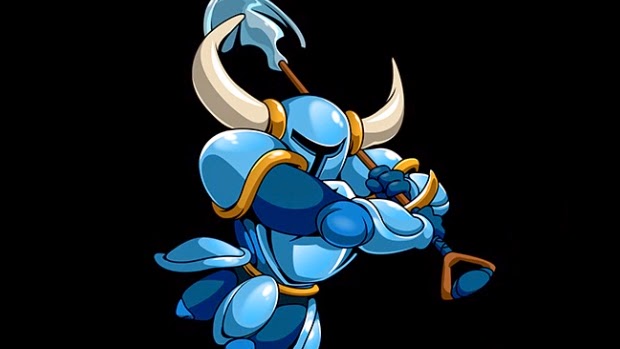
Shovel Knight: A Pristine Pixel Crown

If I asked you, what's the best 8-bit game, what would you say? Castlevania? Mega Man 2? Both are classics, no doubt. But. The best 8-bit game by far is Shovel Knight

Never heard of it? That's because the game just recently came out. A brand new 2D adventure that's guaranteed to flicker your pixelated love pump. Start rotating those thumbs, you'll need 'em to be primed.

Shovel Knight is a 2D action-platformer, made to resemble old 8-bit games of yesteryear. In an industry that rotates triple-A games like used up socks, this may seem like madness. Yet one company (Yacht Club Games) dared to dream in pixels, and launched an ultra successful Kickstarter project that has materialized the most talked-about game of 2014.

taringa.net
Seeking treasure to unearth, Shovel Knight and his companion Shield Knight have entered the Tower of Faith. While exploring the tower, the two knights become spellbound by a powerful dark amulet. Moments later, Shovel Knight awakens without his comrade.

What's a noble to do, but ready his shovel and brave the challenges ahead!

The graphics are sharp and vibrant. And the sprites – while pixelated – are surprisingly clean and detailed. The colour palette mirrors Nintendo's entire range of bustling 53 colours, with about 12 colours displayed at a time. Add some solid parallax scrolling for depth, and you got a game. A game that is not about the graphics; but about depth of gameplay, and a renewed crusade for innovative play mechanics.

It's all about the soul within it the armour: remember that, all you future squires.

There are shops to visit, castles to storm, and errands to solve. Doted across the mini map are numerous locals in need of good ol' shoveling. Each castle is home to a unique knight, that must be dethroned to progress farther. But getting to the last screen is no easy task, perils are everywhere. The jumps need to be timed PERFECTLY, enemies need to be utilized as living platforms, magic needs to rationing, and bonus abilities have to be unearthed to make progress a bit easier -- this game's everywhere you wanna be.

wired.com
You're not considered a gamer until you've balanced yourself while bouncing on a moving gear, just to execute a perfectly timed vault over a chasm, while phasing through that one flying foe that's about to ram you into a pit. Luckily, there are many useful skills/items to purchase and find: fireball wand, a rustic gear platform, arcing anchors, rolling blob balls, and several armours to craft. While the game is challenging, it's never unfair, because every time you perish you only loose a portion of cash – which can be recovered, providing you make it back to reclaim it.

The game's world is filled with quirky characters, who spout offbeat lines, making you smirk every time a text box pops up. The writer has a flair for penmanship, unleashing streams of text that flood your cerebellum with goodness. Chatting with an NPC is never dull. On par with the writing, are the lovable characters: anthropomorphic horse maidens, goat scholars, frog gentlemen, twisted tree-bards, propeller wearing mice, shifty ghosts and sleepy yellow dragons! It's a strange brew of men and beasts, oh so delightful.

indiepitome.com
The Boss Knight encounters are very a la Mega Man: with foes unleashing patterned onslaughts, which can only be quelled by practiced counter-attacks. I don't want to give away too much, but this game will demand that you remember your repertoire of moves quickly. It's quite amazing how much personality is contained within all those pixelated sprites. And since ROM is not an issue, the game contains a fair amount of lengthy content, and lots of chiptune music that will shovel its way into your groove veins.

Shovel Knight pays homage to the glorious and memorable games of your youth, and unlocks that special time and place you've stored away inside a nostalgia box. The game reanimates that perfect freeze-frame in time, where you're pulling on the controller as if it's going to extend your jump trajectory. Or that moment when you have finally managed to defeat the last boss, and you're stomping about the basement, joyous and victorious, at 2 am.

This clever title latches onto that youthful magic, and asks only to be enjoyed wholeheartedly and repeatedly. And what it gives back is totally wonderful: A continuation of the best time of your life. I tip my golden chalice, and wish for all the Lord Knights to return once more.

Shovel Knight gets five jewel-encrusted shovels out of five.

Developer: Yacht Club Games
Publisher: Yacht Club Games
Platform: 3DS, Wii U, Windows, OS X, Linux
Released: 2014
Genre: Action-Platformer

You'll Dig It!
 

Mar 13, 2014

Growing Up Gamer: From Bits to Infinity

I'm leisurely lounging on my couch, enjoying a laid-back Saturday afternoon. Sipping some juice. Playing Super Mario World. Letting my mind wonder in 2D lands. And an unexpected ring-tone tugs my awareness back to reality.

A quick glance at my surroundings confirms there's nobody home but me. I lift the nettlesome receiver.

“I got the game!”
 “... Which game?”
“You know which game, bring your controller now!”
“... You got Street Fighter II, no frigging way!”
 “Yes! And you need to come now!”

My shoes fly onto my feet, 20 seconds flat. I'm out the door, zipping pass the elevator, almost plummeting down the stairway. Two minutes from the time I put down the phone, I'm already at my friend's house plugging my controller into his Super Nintendo. Grinning excitedly because of the upcoming PvP match.

It Began on the Streets 

nintendo.wikia.com
The next two months are spent studying eight unique road warriors, and mastering their intricate thumb-scraping moves. The year is 1992. A decade that was my wondrous entry into the worlds of video games. My initial system of choice: Super Nintendo (with Super Mario World already packed in).

Time was abundant those days, my friends and I would rent games and play them until dawn. Always scouring our neighbourhoods for obscure video game and VHS rental shops – and there ware many. If you wanted to try newly released games, you'd have to hit up The Arcades: Places know as inclusive covenants of amicable characters with diverse gaming skills and knowledge. A lot of gamers I know -- and later became friends with -- I met at the arcades, and the various anime clubs that were slowly popping up around town.

The only way to get gaming news back then was by spending allowance money on the monthly Game Pro/EGM Magazine. And if you were interested in imported games, anime, and comic books, the 'zine of choice was the legendary GameFAN Magazine. Between browsing magazine shelves of our local Scrum Mart, and frantic joystick bashing at the local arcades, we still found time to watch every episode of Video Arcade Top 10, and Game Nation. Yeah, TV was the only way to siphon gaming related news. Radical.

Launched Into Space 
 
evilgeeks.com
Time rolled on, and so did technology. In mere four years 16-bit consoles jumped from 32 to 64-bit. Games became larger, more encompassing, and rich in content. Despite the hasty technological progress, gaming was still considered something only odd nerdy people did. Until the first ever commercial for a video game was shown in movie theatres: Final Fantasy VII.


This Square Enix title summoned a hype of Bahamut proportions. Now, everyone was talking about video games. No doubt, gaming was clearly becoming a mainstream hobby. The release of Hallo on the original Xbox only solidified that fact – and brought reluctant PC gamers to the console market. Microsoft and Sony—with its PS2—continued dominating the gaming industry. Developing and releasing a plethora of wicked and awesome games.

With the advent of the Internet, online capabilities finally descended onto home consoles. Playing video games was no longer an experience shared with a handful of dedicated friends; gaming has gone global. The Big Three: Xbox360, PS3, and Nintendo Wii, were the precursors of change. And each gaming system evolved from a gamer-only platform, to inclusive family-friendly entertainment hubs.

And Latched Onto Our Souls  

giantbomb.com
When playing recent Gen8 super machines, it is clear that gaming has ingrained into our habitual behaviour. Instant access to online sharing tools, integration of relevant social media platforms, reworked iterations of established titles, and we are primed to blast off into digital realms yet uncharted. A new level of collective gaming is now stimulating our synapses. We are witnessing a creation of a new limitless cyberspace horizon.

But after a dramatic all-night session of online play, I sometimes reminisce about the simpler time. A time when being a gamer meant you were confined to a basement room. A game-filled hideout where only a handful of your nerdy friends would want to visit. Very few people understood your hobby, and even fewer knew the difference between a Sega Genesis, and a Super Nintendo. And you were glad for it. Here is one last CHEER to the wonder and fun of Retro Gaming!


GAME ON!


Sep 27, 2013

2D Strollin' With A Boy and His Blob

I remember renting A Boy and His Blob from my local video game store. This was way back in the NES era when my friends and I would rent games for few days, and hope to have enough time between schoolwork to play. 

Right from the start, I was captivated by the game's goofy premise of having a shape-shifting blob as a partner on a treasure hunt. If I only knew it would take 20 years for the remake to appear, I'd probably rent the game a few more times. 

Once I heard about A Boy and His Blob for the Wii, I didn't take me long to seek out and play this, often overlooked, gem. The Wii version is definitely a nod to all the 80s kids who spent countless hours playing their NES instead of studying. Minutes into the adventure I got suddenly nostalgic, and felt as if my mom was about to barge into my room, yelling at me to stop playing and go to sleep. 

g4tv.com
World of Goo 

In this puzzle-platformer you control a human boy who is faithfully fallowed by an AI controlled companion, a peculiar white blob. Their task: stopping an alien invasion of Blob's homeworld. Boy and Blob strolling about and getting into trouble... anyone getting a buddy flick vibe? I'm a big fan of hand-drawn animation and love 2D games: this fresh title mixes both features exceptionally well. 

The backgrounds are painted with vibrant and clean strokes, seamlessly transposing everyday scenery into fantastically imaginative landscapes. Every stage has a surreal feel that will make you want to stop and scan the horizon: tranquil forests beckon adventures, caves and swamps test the nerves, and a nightly city mesmerizes the senses. The Boy and Blob's mannerisms and actions are smoothly animated with painstaking detail, which gives the game a distinctive quality – a la Saturday morning cartoon. 

videogamesblogger.com
Bellyful of Jelly 

Unlike a bumbling cartoon-y sidekick, The Blob does not spew nonsensical gibberish; It does useful things, like transform into objects by eating specific jelly beans. The Boy, being a regular human child, cannot do much except run along, push or jump. But with The Blob by his side he can achieve much more. 

Each jelly produces a delightful new transformation in The Blob. No ledge is too high if your partner can shift into a handy trampoline or ladder. Nowhere to go? Blob can help, by stretching across the ground and becoming a sinkhole (a useful tool for disposing enemies). If you grew up watching Roadrunner cartoons, and always wanted to drop an anvil onto a foe, just feed your Blob the right kind of jelly and bonk 'em.

Unlike to original game, the Wii version is much easier. There are unlimited jelly beans to ingest, and guidance posts to show which abilities will get you through specific parts of the levels. Some of the game's melodic music has a lulling kind of quality to it, which does not convey immediacy, and tends to slow the pacing a bit. However, all of the levels and boss encounters are quite fun, and require use of The Blob's myriad powers in always surprising ways.


dpadmagazine.com
Tale of Friendship

There's a certain story-book cuteness to this game, making it wonderfully appealing without being sappy or cheesy. The Boy's reliance on Blob's out-worldly abilities builds a bond between the two characters, which seamlessly grows with each new challenge. I dare you not feel wonderfully happy at the heartwarming way in which the Boy hugs The Blob, or how he carefully packs his companion into a knapsack so it can became a parachute. 

It's great to see a game that can convey emotions without relying on realistic graphic, or complex story lines weaved with over-top action sequences. WayForward managed to capture the charm of the original, no doubt. Action-savvy junkies may not like the slow and methodical way of progression in A Boy and His Blob; that's okay, because this is a game that reveals its elegance when played in a carefree way. The way you played games when nothing else mattered – not even your homework. 

“What! No, I don't have to finish my Geography project tonight, mom!”

Developer: WayForward
Publisher: Majesco Entertainment
Platform: Wii
Released: 2009
Genre: Platform-Puzzle

avclub.com